

Open 24 hours, until it isn't.
On diners, disappearing knowledge, and what loyalty actually required.

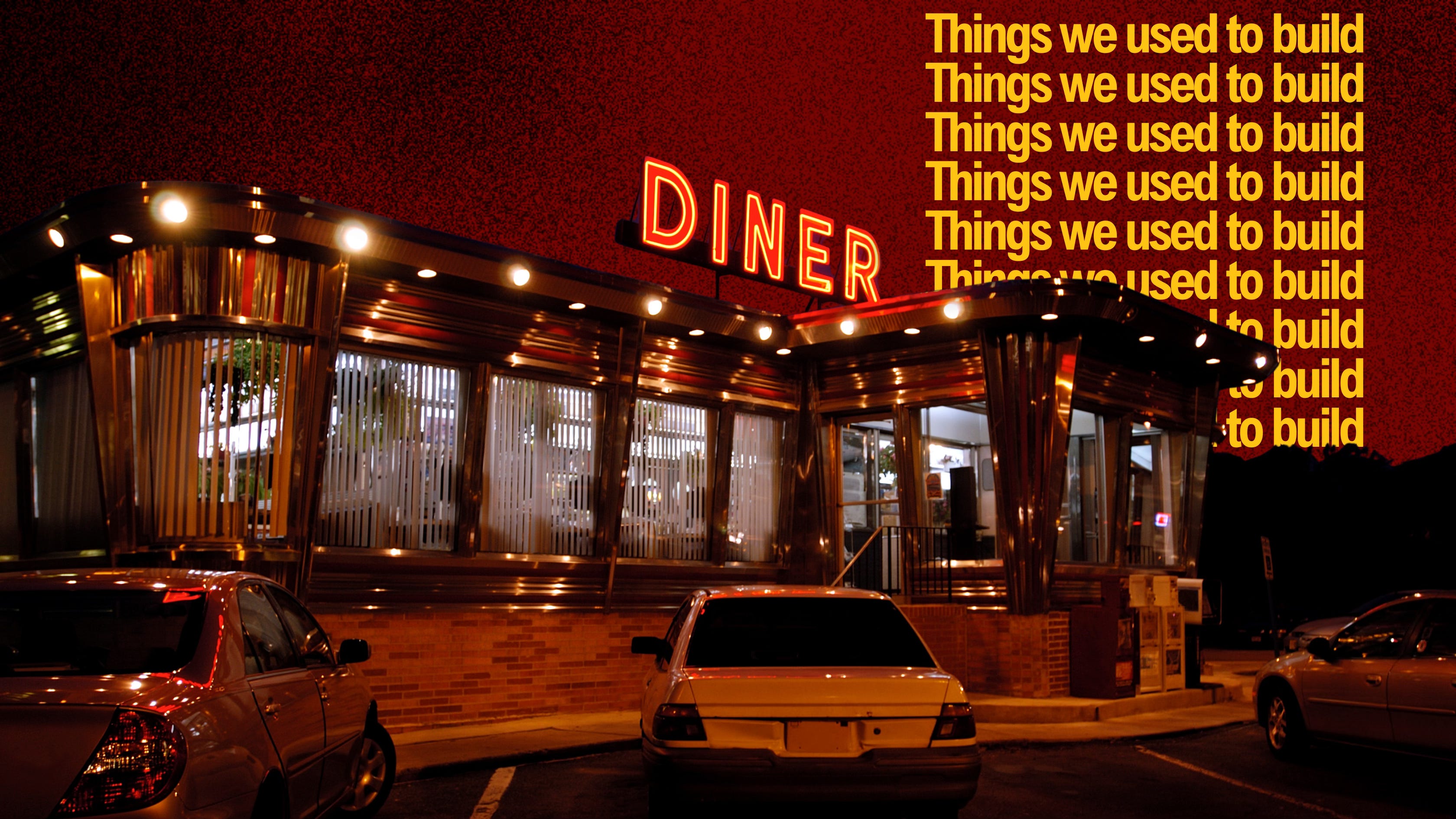
When my brother visited Canada, I took him to a diner in Ottawa. He had never been inside one. Neither of us grew up in North America, and the diner is a deeply American concept not just a type of restaurant but a whole argument about who deserves to be fed and at what hour and without having to perform for it. I wanted him to feel what I had felt the first time: not comfort, exactly. More like walking into a room that already knew what you needed before you opened your mouth.
That feeling has a name. The industry is spending billions trying to buy it back.
The diner began not as a building but as a gap to fill. In 1872, a pressman in Providence named Walter Scott converted a freight wagon, parked it outside the Journal offices, and started selling coffee and sandwiches to workers coming off the late shift, the people the restaurants had already closed on. The lunch wagon went stationary by the early 1900s, got prefabricated and shipped across the country in the 1920s, and became the luncheonette: smaller, faster, built for the worker with forty minutes and no illusions about it. The Greek diner is a later chapter in the same story. Greek immigrants arrived with few options, took the jobs no one else wanted, paid attention, saved, and began buying out exhausted owners often with a brother or a cousin. By the 1990s, two-thirds of New York City’s diners were Greek-owned. One wave fed into the next. The form changed hands and kept its function.
The function, across every iteration, was the same: feed people who need feeding, without asking them to perform in order to receive it. No concept. No vibe requirement. No version of yourself you have to show up as.
Here is where the diner stops being a restaurant story.
The independent restaurant sector lost over 9,500 locations in 2025 alone shrinking 2.3% while chain locations grew 1.4%. Around three hundred diners remain in New York City, down from thousands. The closures aren’t mysterious: rents that doubled, then doubled again; a generation of owners’ children who looked at the hours and the margins and made a different choice. What replaced them isn’t always a ghost kitchen or a luxury condo. Sometimes it’s a rebranded version of the same place — a clean sans-serif logo, a menu edited to twelve curated items, a reservations system, a QR code where the laminated menu used to be. It kept the word diner. It removed the thing the word pointed to.
The rebranded version knows how to look like it knows you. The original one actually did.
I have a regular diner now. Lake View, on Dundas West in Toronto, open 24 hours. The server doesn’t write down your order. The coffee appears before you’ve formed the thought. There is a shorthand between a regular and the person across the counter that operates without language, almost without eye contact. It is built from repetition until it becomes something closer to care.
What’s interesting about diners is that the customer knowledge doesn’t live in a system. It lives in the body of the people doing the work. The line cook who knows the couple in the corner booth wants the window seat, that she takes her eggs over easy, that he stopped ordering the hash browns three months ago and won’t say why. Losing that person is not just a staffing gap. It is the loss of the accumulated record, years of observation that never existed anywhere except in practice, in the body of someone who showed up every morning and paid attention.
The gap is visible in the data.
80% of customers say their issue was resolved through AI or hybrid AI interaction. Only 22% say the experience made them prefer the company. Resolved, but not loyal. That gap between closed and felt, between transacted and remembered is the whole problem. And it’s a problem the diner never had, because the diner wasn’t resolving issues. It was building a relationship, over time, through proximity and repetition and the particular intimacy of a short-order kitchen operating under pressure across a very long shift.
The relationship economy did not invent this. It discovered it had lost it. And then it built a subscription tier around finding it again.
What made it possible in the first place was constraint. The short menu is not a limitation. It is a position. We know what we do. We do it without apology. That legibility is what trust is built from and it is the first thing to disappear when something gets rebranded into a concept, or when a loyalty platform needs to justify its renewal to a board, or when a product team adds a feature because the roadmap required it.
Which means there is a vacancy. Not a nostalgic one. A structural one.
There is currently no orientation in brand building, no dominant model, no celebrated case study, no funded startup that treats knowing its people not as a feature but as the whole point. Every personalization play in the market is built on data the customer didn’t knowingly give, optimized for behavior the customer didn’t consciously choose, toward outcomes the customer wouldn’t recognize as care.
The diner held this knowledge in muscle memory and accumulated attention. It treated recognition not as a growth lever but as a reason to exist. That’s a different architecture entirely. And right now, nobody is building it.
My brother still talks about that diner in Ottawa. Not the food or the booths. The feeling of sitting down and being expected, not performed for, not optimized at, just quietly expected. Like the room had been keeping a seat. We used to build things like that.
If you want to join Perceptio Office Hours to discuss some of the topics live together, consider upgrading your subscription. All posts will remain open and free regardless.
Perceptio is now also on Instagram in case you want to follow: @perceptio.substack
About Kima
Kima Sargsyan is a strategist and narrative consultant writing Perceptio. She works with founders and execs on how their company is seen and how to shape it.
Want to keep talking?


I loved this article a lot. Real and non-performative emotions are needed in any business. They are truly felt by a lot of customers.
in a sense, personalization is what you do when you've already lost the relationship and you're trying to fake your way back to it. great piece!