

You have to make them feel the pomegranates
What it takes to make a stranger want to go somewhere they've never been.

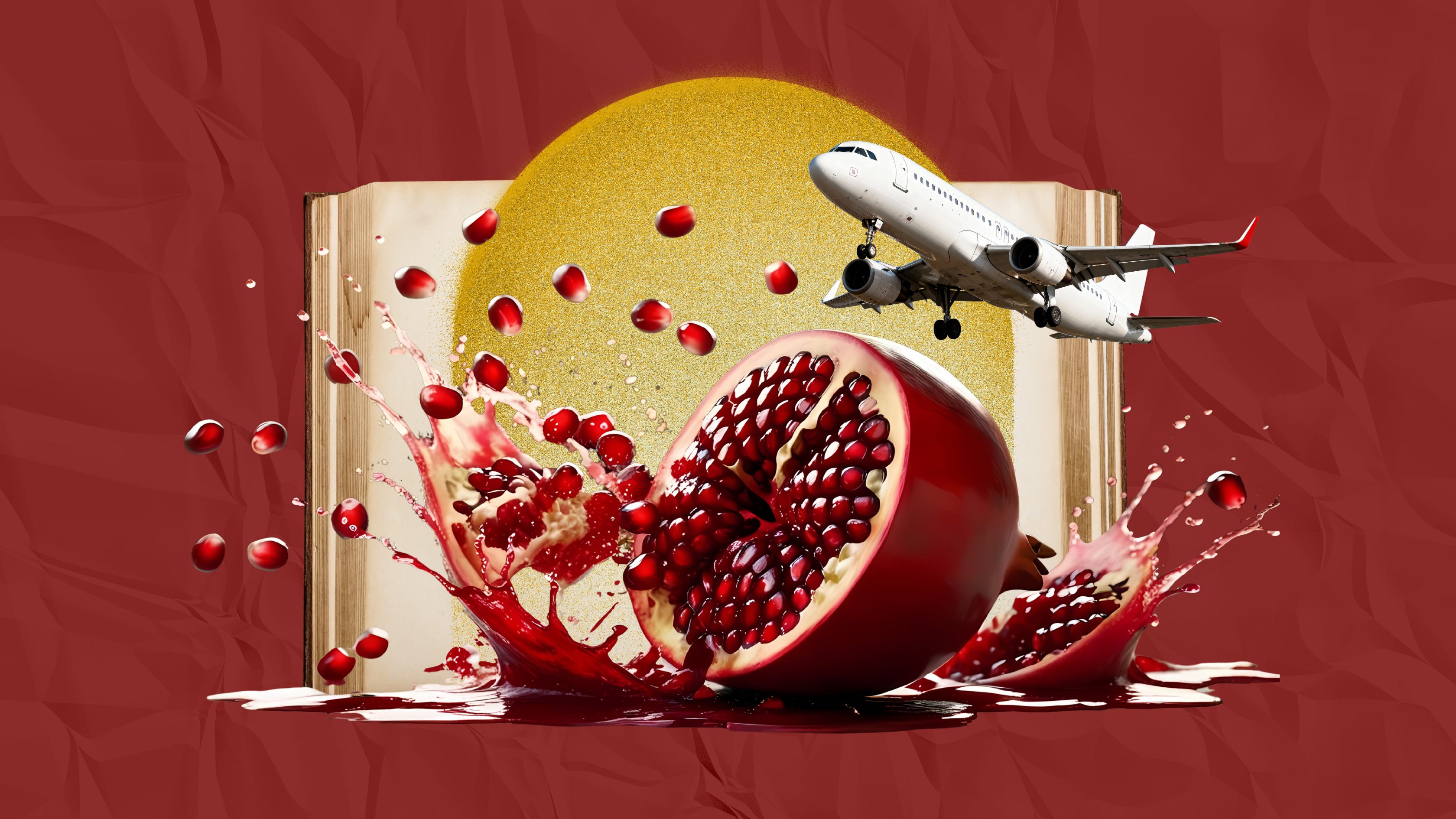
The pomegranate (nur) is an Armenian symbol of fertility, abundance, good fortune, and the resilience of the Armenian spirit. This famous closing line for Armenian fairy tales, “Three pomegranates fell down from heaven: One for the story teller, one for the listener, and one for the whole world,” symbolizes the sharing of wisdom, the connection between people, and the spread of stories. The phrase is traditionally used to conclude Armenian fairy tales, ensuring the story's lessons (the "pomegranates") are distributed to the narrator, the audience and the world at large.
***
I spent part of my early career trying to convince people to visit Armenia.
I was inside a travel agency, responsible for translating a country, its mountains, its khachkars, its apricot-colored light into something that would make a stranger in a foreign city open a browser tab and think: yes, that one. That’s where I’m going.
I did not fully understand, at the time, what I had been handed. I do now.
You may wonder why I’m writing about this now, in the middle of … well, everything. The answer is simple: when the world feels unstable, people reach for somewhere to belong. Destinations don’t matter less in chaos. They matter more. The need to feel held by a place, to be somewhere that has a texture and a logic and a version of hospitality that predates the news cycle, doesn’t disappear when things get hard. It intensifies. Which means the people responsible for translating places into feeling have never had a more important job.
Destination marketing is one of the most demanding forms of storytelling that exists in professional practice. I don’t say that the way people say every industry is creative if you look at it right, because I don’t actually believe that. Some things are richer and more resistant and more interesting to communicate than others. A country is one of the hardest. A country where the people doing the communicating are working against a century of being misunderstood, unmapped by the mainstream cultural imagination, reduced to a handful of facts the world half-remembers — that is something else entirely.
Questions the brief doesn’t ask
The Armenia brief, as I came to understand it, was a cascade of questions that had no clean answers. How do you describe food through a screen? Make someone feel the sourness of matsun, the weight of dolma assembled by a grandmother who learned from another grandmother, the specific pleasure of lavash that was baked that morning? How do you establish safety without the word safety, which announces the anxiety it’s supposed to dissolve? How do you hold the mythology lightly — the first Christian nation, the wineries, the genocide that reorganized a diaspora across three continents without making it a burden the traveler has to carry? How do you say: we speak your language, meaning not linguistically but culturally, meaning you will not be lost here, meaning the hospitality is real and the curiosity goes both directions?
And underneath all of it: how do you make one country feel more necessary than everywhere else, when everywhere else is also beautiful and also ancient and also waiting?
The most honest brief in the industry
Strategist and marketers should practice destination marketing at least once. Not as a specialty. As a discipline. It is a compressed version of every hard communication problem that exists. The place punishes abstraction. It demands specificity in a way most briefs never force you to confront. If you can learn to describe a place, its smell, its texture, its social contract, through a screen, to someone who has never been there and is not yet sure they want to go, you can communicate anything.
Here is where destination marketing stops being a tourism question.
Every country has an official story and a lived one. The official story is flatter, safer, more photogenic. The lived one has texture and contradiction, the kind of specificity that makes people feel, when they encounter it, that they’ve been trusted with something true. The real job is to find that story and make it legible without destroying it. Not flatten it into stereotype. Not over-mythologize it until the locals don’t recognize themselves. And not sanitize it into content, drone footage of something ancient, a tagline about discovery, a traveler’s face expressing the correct amount of wonder. Beautiful. Inert. A place they’d like to visit someday. Someday is not a booking…
Three paintings, three Californias
Fast forward many years. I no longer work in the travel industry. But after visiting the Bowers Museum last year, I found myself wishing I’d had a chance to tell the stories of California.
I was there for a client meeting, Santa Ana, not the California of the imagination, not Venice Beach or Napa or the highway Joan Didion used to drive like a reckoning. I had a few hours before my flight back to Toronto. I found the Bowers Museum. And I stood inside it thinking: this is the thing. This is what it looks like when a place becomes a subject rather than an object.
The Bowers is a strange and beautiful institution. Its permanent collection holds more than 100,000 objects spanning pre-Columbian Mesoamerica, Native American art, Asian and African traditions, Pacific Islands and threaded through all of it, a gallery dedicated to California’s own visual history. The argument the museum is making, just by existing as it does, is that California is not one story. It never was. It is where the Pacific Rim arrived. Where Mexican and Spanish traditions became architecture and land and rancho and then became other things. Where Indigenous life was systematically erased and then partially recovered and then held alongside the erasure, both things true at once.


I stood in front of a painting called Jeff, the Horse Ambulance Driver of the County Hospital, by William Joseph McCloskey. Jeff is a person. A specific person, named, assigned a role that sounds like an institution unto itself. It stopped me completely, it was so particular. This was California rendered as character study, as portraiture of labor and daily life, not as golden hills and infinite promise. A few steps away, La Buenaventura by Charles Percy Austin using his wife, Martha Austin, as a model for the tarot card reader depicted. Entertainments like fortune telling and flamenco were staged for tourists during pageants and fiestas at the California missions.
And across the room, an untitled work by Emilío Vásquez, the Chicano muralist the Bowers had commissioned decades earlier, “The Godfather of Chicano Artists,” whose work insisted that California’s face was also brown, also Mexican, also working-class and sacred simultaneously.
Three paintings. Three entirely different Californias. All true. None sufficient on its own.
California doesn’t need to be marketed. I loved it way before I ever landed there. I read Didion and I read Steinbeck and I arrived already knowing what I was walking into. I landed fluent. The place felt like recognition rather than discovery.
But what the Bowers made visible is that the California marketed for export, the one I absorbed through literature and film, is one slice of a deeply layered identity. The rest of it is there: in the plein-air paintings and the Chicano murals and the Mesoamerican artifacts that remind you this region’s cultural memory stretches thousands of years before IG, influencers, content.
The places that do destination marketing well hold all of it. Not the version made for export. The version that carries its own contradictions with dignity, that trusts the audience to hold complexity rather than handing them something digestible and inert.
This rarely happens on purpose. It happens because someone found a true detail and refused to simplify it. Didion wrote about California’s Santa Ana winds as moral weather — hot, electrical, the kind that makes people behave badly and suddenly the state had an interior real life description that no tourism board had commissioned.
Mayes wrote about a farmhouse in Cortona named Bramasole (meaning "to yearn for the sun"), that needed everything, it was in need of extensive renovations, having been vacant for years, with a vineyard overgrown with brambles. Suddenly, Tuscany became the geography of reinvention for a generation of readers who had never been there and already loved it.
These were not campaigns. They were specific acts of noticing. And they traveled further than any tagline.
The gap between what a place carries and what it’s been given credit for
What I learned from trying to market a country is that the best destination work plants something that grows after the campaign ends.
The question every good brief should start with is not: what do we want people to feel? It is: what does this place know about itself that the world doesn’t know yet?
That gap between what a place carries and what it’s been given credit for is where every honest campaign begins. Most campaigns never find it. They start instead with the version that’s already legible, already expected, already a little flattened. And they produce beautiful content that confirms what people already assumed.
The destination marketer’s job and the strategist’s job more broadly is to go one layer deeper. Past the official story. Into the specific, resistant, living thing underneath.
About Kima
Kima Sargsyan is a strategist and narrative consultant writing Perceptio. She works with founders and execs on how their company is seen and how to shape it.
Want to keep talking?


