

The futures we inherit vs. the futures we invent
THE FUTURES, a new series from Perceptio.

THE FUTURES is an invitation to look forward. We chase possibilities knowing they'll shift. That's the point. Imagining shapes becoming. We deserve futures worth building toward.
Perceptio is now also on Instagram in case you want to follow: @perceptio.substack
We live in the most data-rich moment in human history, with more processing power and pattern-recognition tools than any previous generation. So why are we worse at imagining the future than civilizations that navigated by stars?
In January 2026, social media is flooded with nostalgia for 2016 a year defined by political rupture and cultural anxiety now being remembered as simpler, more legible. Even our escapism has become backward-looking.
This isn’t random. It’s a symptom of something larger: we’ve lost the capacity to imagine futures worth moving toward.
For the past decade, the future arrived pre-packaged. Tech keynotes told us what we’d want before we wanted it. Industry trend reports predicted each generation’s behaviors with such confidence that for a moment you might think the whole generation would act, buy, think exactly the same way. The future became something that happened to us—a destination we were being transported toward, whether we’d chosen it or not.
This is the inherited future: the one assembled from other people’s predictions, anxieties and investment theses. It’s the future that shows up in pitch decks and earnings calls, already named and monetized before most people have decided if they even want it.
This comes with a challenge: When every brand in your category has access to the same trend reports, trend reports stop being competitive advantage. They become the baseline for sameness.
But there’s a deeper problem. The signals themselves are built on narratives that are actively collapsing.
“The future does not exist, we can only imagine it. By expanding how we imagine futures, we can see the present differently and learn how to embrace uncertainty.” — Loes Damhof, UNESCO Chair on Futures Literacy
The creedal passion cycle
Samuel Huntington identified something in American history that most strategy frameworks miss entirely: 60-70 year cycles of what he called “creedal passion”—periods where the delta between the promise and the actuality of a society becomes too large to paper over. The gap between what we say we believe and how we actually live grows until it can no longer be ignored.
We’re in one now.
The last time people were this polarized, this ready for massive change, was the 1960s. Joan Didion captured that moment in Slouching Towards Bethlehem—the center not holding, the old stories failing to explain what people were actually experiencing.
What strategists tend to miss is that these cycles aren’t just about politics. They’re about the exhaustion of inherited narratives. The stories we’ve been told about how the world works and should work stop making sense. The metaphors break down. And in that breakdown, new possibilities emerge.
The narratives most brands still operate on were built for a different cycle: Perpetual growth as the measure of success. Optimization as the highest virtue. Convenience as the ultimate value proposition. Aspiration as the engine of consumer motivation.
These aren’t wrong, just extensively exhausted. And organizations still building on these foundations aren’t just unoriginal, they’re building for a world that’s being actively rejected.
“We treat our future selves as a stranger, and the future as a foreign land. It’s not a foreign land; it’s unfolding right in front of us, continually being shaped by our actions today.” — Anab Jain, Superflux
The evidence is everywhere
Once you see the narrative collapse, you see it across categories. What emerges is a pattern: a generation making the same choice for the same reason, refusing the future they were sold.
The rejection of optimization: 21.8-22.8 million Americans are working part-time as of April 2025 (FRED), nearly five times the number of involuntary part-timers. The work-reward equation isn’t just changing, it’s being refused. Hard work and reward are decoupling. If it seems like working harder, being more loyal, trusting the system no longer promises greater economic or social capital, then it’s rational to de-prioritize work entirely. It’s a values realignment that most workforce strategies haven’t priced in.
The rejection of productivity as identity: The hustle culture narrative told us leisure was earned through achievement. That story is collapsing. The global wellness economy has doubled since 2013, reaching $6.8 trillion in 2024 growing at 7.9% annually, nearly twice the rate of global GDP (Global Wellness Institute, 2025 Global Wellness Economy Monitor). Meanwhile, employee engagement in the U.S. hit an 11-year low in 2024, with only 31% of workers engaged 4.8 million fewer than the previous quarter (Gallup). People are simultaneously spending trillions on rest and checking out of work. Rest is being recognized as a necessary state of being, not a break in productivity that requires justification.
The rejection of algorithmic convenience: According to Pew Research Center data, social media usage has plateaued at 82% since 2021 and isn’t budging. Global minutes per day spent on platforms have started to decrease. People are opting out. The convenience narrative promised frictionless connection would make us happier. It didn’t. Now the competitive advantage is shifting to brands that offer intentional friction, earned access, curated scarcity.
These aren’t separate trends. They’re symptoms of the same underlying shift: the inherited narratives are failing, and people are building alternatives with their behavior before they can articulate it in language. The 2016 worship, the comfort rewatches on Netflix and so on isn’t about loving the past. It’s about the future feeling foreclosed. When you can’t imagine a tomorrow worth building toward, you turn backward.
The cost of building on collapsing foundations
Here’s the strategic risk most organizations haven’t confronted:
If your brand strategy still assumes people want to optimize their lives, you’re speaking a language that’s losing native speakers. If your value proposition is built on convenience, you’re competing in a race where the finish line is moving. If your growth model requires perpetual aspiration, you’re betting on a motivation that’s exhausting itself.
This isn’t about being on the wrong side of a trend. It’s about building on narratives that are actively being rejected. The cost isn’t just irrelevance, it’s that every investment you make in the inherited future deepens your commitment to a world that fewer people want to live in.
Take Meta. In 2021, they bet the company on the metaverse, a future where we’d want to spend more time in immersive digital environments, where optimization and convenience could be pushed even further. The vision hasn’t materialized (with reports from late 2023 mentioning around $46.5 billion in losses since 2019, and later reports from late 2025 pushing total losses for the division to over $70 billion, as detailed in sources like Fortune) because the underlying assumption was wrong. People weren’t rejecting the metaverse’s execution. They were rejecting the premise that more digital immersion was a future worth wanting.
What invented futures look like
The alternative isn’t better prediction. It’s active observation and multi-future planning.
Anab Jain, co-founder of the design studio Superflux, calls herself “an archaeologist of the future.” Her team doesn’t forecast, they build. hey constructed a London apartment from 2050—a project called Mitigation of Shock—where climate change has moved the West from abundance to scarcity. The project visualizes a London apartment in 2050 that has been forced to adapt to severe climate change, including extreme weather, supply chain failures, and food scarcity.
Loes Damhof, UNESCO Chair on Futures Literacy, approaches the problem from the other direction. In her Futures Literacy Labs, she asks participants to imagine something deceptively simple: how will people gather in 2070? The exercise is about surfacing the hidden assumptions that already govern present decisions. What do you unconsciously believe about technology, community, connection? Those beliefs are shaping what you build today.
Both are expanding the range of futures that feel possible to imagine. Not because any single imagined future will arrive intact, but because the act of imagining multiple futures is what keeps the inherited future from being the only one we can see.
This is what it looks like to build on different foundations. Not predicting what comes next, but observing what’s already emerging and understanding that observation itself is a form of futures work.
In 2026 and beyond, companies and brands should develop this muscle: the capacity to see which narratives have run their course and to build on what’s actually emerging rather than what’s supposed to come next.
Temporal cartography
A framework for THE FUTURES
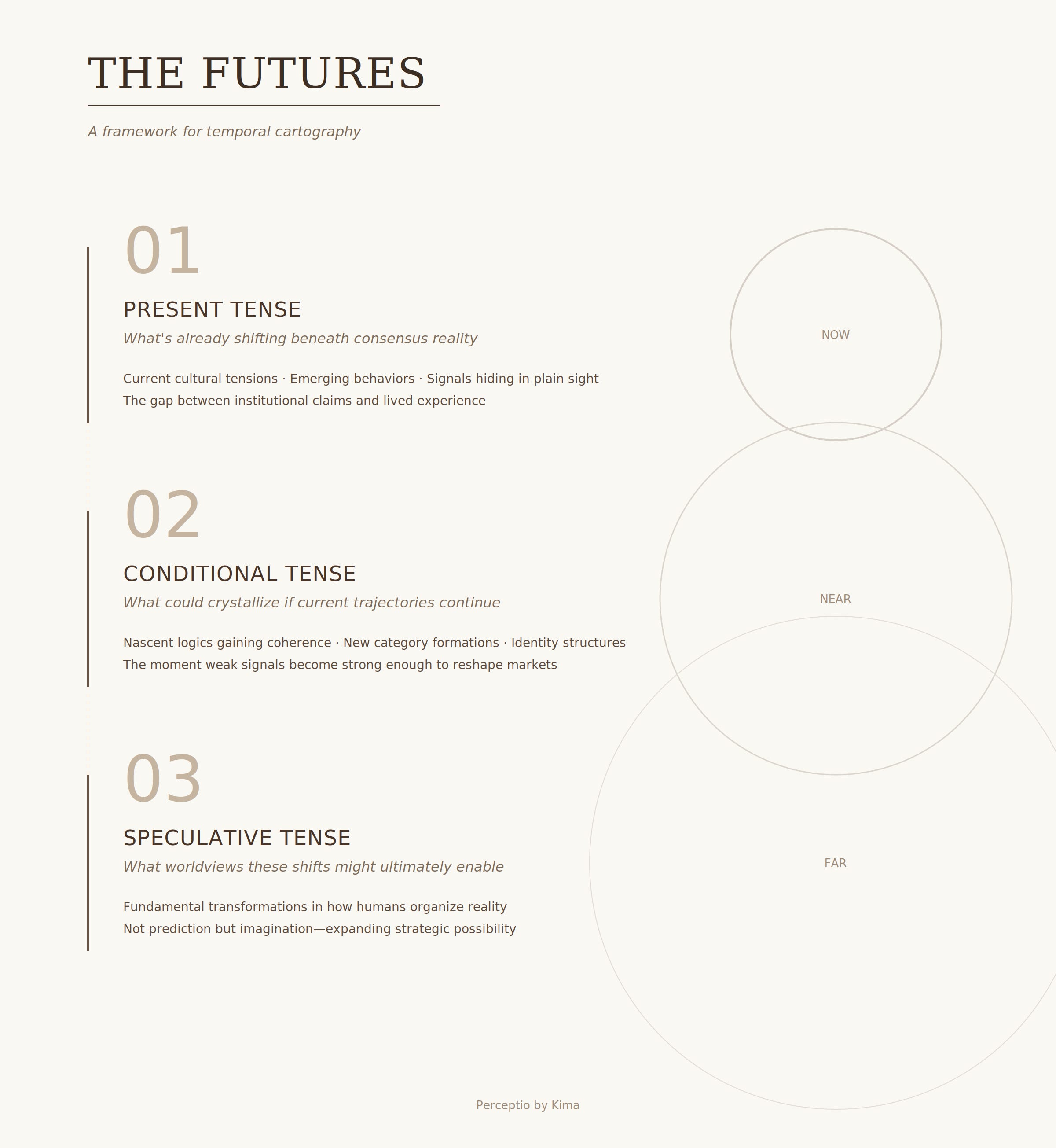
THE FUTURES isn’t trend forecasting, it’s temporal cartography. Each essay will map an emerging cultural territory across three horizons: what’s already shifting beneath consensus (present tense), what could crystallize if trajectories continue (conditional tense), and what worldviews might ultimately emerge (speculative tense). The goal is to expand strategic imagination around what’s becoming possible.
The posture for 2026
The futures we inherit are someone else’s hypothesis about what we’ll accept. The futures we invent are evidence of what we actually want.
The black swan most strategists and businesses imagine is a faster competitor, a better optimization. But that’s not the real threat. The disruption won’t come from someone who executes the inherited playbook more efficiently. It will come from someone operating on entirely different premises, someone whose assumptions make the old ones unintelligible.
Which means creativity isn’t a department. It’s a muscle. It atrophies without use and strengthens with practice. We must treat imagination as discipline, not a quarterly brainstorm, not an offsite exercise and we will see what’s emerging before it has a name.
The rest will keep building toward a future that fewer people want to live in.
The FUTURES | VOL. 2

Kima Sargsyan is a multi-disciplinary strategist and futurist writing Perceptio. She helps brands locate the honest contradiction between what their category expects and what only they can credibly do. If your team needs someone to show what else is possible and challenge comfortable assumptions: let’s talk.
Continue reading Perceptio


