

The auction room in 2040: what gets to become vintage
Hello from the future. Glad you made it.

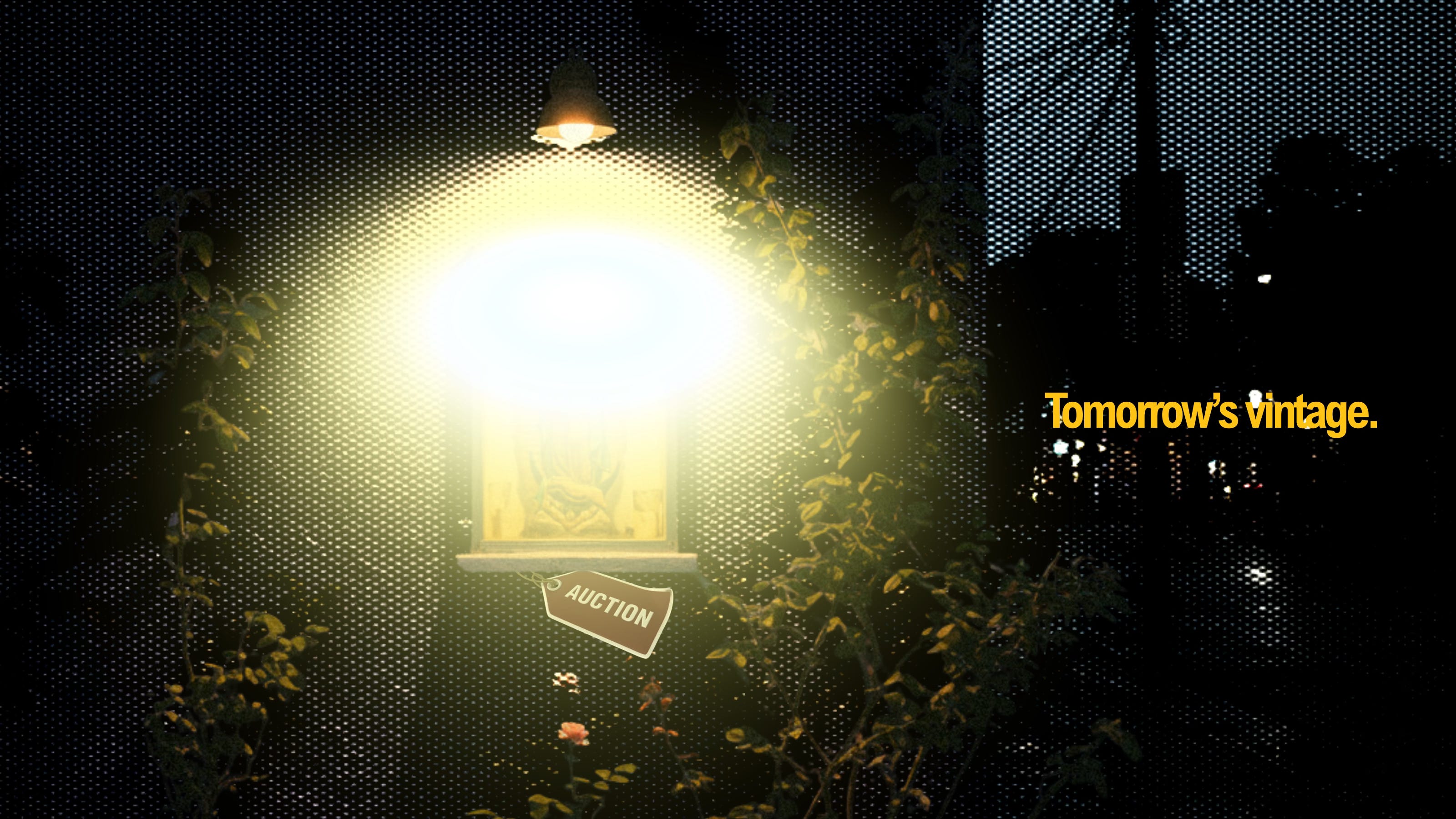
So, it is 2040. You and me, my dear reader, are old but wise (I hope). We are both watching how somewhere prominent maybe New York, London, Paris, or Hong Kong, the auction room is full. People are here to spend real money on something that represents a very specific time in the history.
Let’s assume for the sake of the exercise, the object on display is small. Unassuming, almost. A few people near the back can’t quite make out what it is. Someone leans to the person beside them and whispers: this is from the beginning of the 2000s. The person nods slowly, the way you nod when something confirms what you already suspected. When the hammer falls the number on the board is $40,000.
The room goes quiet.
Now here is the question: what is the object?
Not what you hope it is. Not what feels significant to you right now, inside this moment, where you cannot yet see the shape of the era you are living in. What it actually is. What survived. What someone in 2040 recognizes as irreplaceable evidence of how this particular world felt from the inside and is ready to pay for accordingly.
This essay is the attempt to answer that. Which means it is also, inevitably, about right now. About what we are making, what we are discarding, and what we are failing to understand about the value of the things passing through our hands.
The first thing to get right is the taxonomy. Because we collapse three genuinely different categories into one word, vintage, and in doing so lose the entire mechanism that makes any of them valuable. I will use fashion as an example, although this piece is not limited to fashion in idea.
Old is just old. Time passed. The 2009 mall dress. It existed. Nobody is coming for it in 2040.
Vintage requires more than time. Vogue places it at roughly twenty to under a hundred years for clothing, but the years are almost beside the point. What matters is rarity, proven quality, a specific cultural mood crystallized so completely that the object becomes evidence of a period rather than a souvenir of it. A souvenir is commemorative. Evidence carries weight. The 1997 Prada nylon bag is a quintessential example of a movement led by Miuccia Prada that redefined luxury by intentionally rejecting traditional, opulent beauty in favor of industrial, functional, and intellectually subversive design. That utility could be luxury. That anti-glamour with enough conviction became the most glamorous position available. That decision is gone. The bag proves it happened.
Archival is something else entirely. Not just era-specific but vision-specific. Significant pieces from a designer's past that carry collector weight because of what they represent within a singular body of work. All archival items may be vintage, but not all vintage items are significant enough to be archival. The Mugler SS1992 construction. The Galliano for Dior F/W 2000 Haute Couture. These trade like art because what they carry is irreproducible — a mind at the height of its argument, in quantities that were always finite, inside a cultural context that has not returned.
Mugler Spring 1992 or Thierry Mugler Spring/Summer 1992
ARCHIVAL F/W 2000 Christian Dior by John Galliano Haute Couture
What produces lasting value across fashion, cars, furniture, wine, ceramics, and increasingly digital objects that found a way to become physical, is a set of conditions that time alone cannot manufacture. They were either present at the moment of making, or they were not.
Material irreproducibility. The thing was made in a way that cannot be replicated today. The Bottega Veneta intrecciato weave takes fifteen hours (sometimes even up to 40-100 hrs) of skilled artisan work per bag and loses what it is the moment it’s automated. When the process disappears, what it produced becomes irreplaceable. Not because the object is rare, but because the way of making it is gone.
Cultural crystallization. The object embodies a specific mood so completely it stops being a product and becomes proof. You cannot restage the moment. You can only find what survived it.
Scarcity through attrition. Most things are discarded. The objects that survive do so because someone chose, deliberately, to keep them, which means someone recognized value before the market did. Survival is its own form of curation. This applies to physical objects and increasingly to digital ones: when a platform dies or pivots, what was made on it becomes inaccessible. Myspace pages, early YouTube, the Tumblr era... Already partially lost. What survived is already scarce.
Insider legibility. The most valuable vintage objects only make sense if you already know what they are. The Margiela white label to the untrained eye is an unfinished garment. To someone who knows, it is a precise refusal of the entire system of fashion celebrity. The knowledge is the currency. It always is, and the more rarefied the knowledge required, the higher the ceiling on value.
The contrast effect. Objects become more desirable as the present moves away from what they represent. Vinyl became collectible after streaming. Film cameras became meaningful after the iPhone. The combustion engine is becoming mythic as EVs normalize. In 2015, Kim Kardashian published Selfish: a physical book containing images that already existed on her Instagram, printed and bound and distributed at the exact inflection point before the culture got embarrassed about the selfie era entirely. It is more interesting now than it was then and will be more interesting still in 2040. The contrast effect only compounds. The greater the distance between what an object represents and what the world has become, the more it functions as proof of something lost.
The vintage window is not fixed at twenty-five to thirty years. It depends entirely on how fast the preceding era closes, and eras close at different speeds depending on how completely the next paradigm replaces them.
Fashion cycles run twenty to twenty-five years. Y2K peaked around 2000 and became coveted around 2023. Furniture takes thirty to forty. Mid-century modern peaked in the 1950s and became collectible in the 1990s. Cars were running twenty-five to thirty-five years until the shift from combustion to electric compressed everything, because paradigm breaks don’t wait for the average. The 1970s Porsche is already mythic not because enough time has passed but because what it represents, the mechanical era, the analog relationship between driver and machine, is visibly ending.
Technology objects move fastest of all. The original iPhone is proto-vintage at nineteen years old. The world it represents is already historical. Does it have vintage or archival value though?
Which means certain years carry more weight than others. The year of production is not just a number. It is a position relative to the ruptures.
Pre-2007 is already historical. The before-picture.
2007–2019 is in early vintage formation. The full DTC decade, peak algorithm, the experience economy at full height. The 2012 Supreme drop. The first Kinfolk run. The Céline tote under Phoebe Philo. The natural wine from the producer who stopped. Some of these already have waiting lists.
2019 is the last year of the old normal. Objects produced that year carry a specific weight in retrospect. Made without knowing what was coming. The last collection before the pause.
2020–2022 carries something historically unusual: objects made during a collective suspension of ordinary life. The hand-thrown ceramic bought from an independent maker when physical retail collapsed. The risograph print produced when no one could gather. The rupture is already inside the object.
2022–2024 has the quality of fever. Revenge dressing, revenge travel, revenge spending. Daniel Lee’s brief, intense Bottega era. Already a closed chapter. Already being looked back at.
2025 is the last window before AI mediates everything at scale. Objects made entirely by human hands, human minds, human creative direction with no AI involvement in their conception or production will carry a designation in 2040 the way pre-war carries one now. The provenance will be the point.
So. Back to the auction room.
The object on the block in 2040 is not what you think it is. It is probably not the thing you are most proud of from this era. Not the most famous thing, or the most expensive thing, or the thing that got the most coverage.
It might be a first-edition Kinfolk from 2011. A Phoebe Philo-era Céline bag from 2013. A natural wine from a producer who stopped. A specific Supreme drop. A printed, numbered, hand-distributed zine from 2020 made by someone who turned out to matter. A Substack archive, printed and bound, from the window when independent writing felt like the most radical act available.
It might be something you own right now and don’t know what you’re holding.
The vintage market is not a nostalgia economy. It is a collective unconscious audit running in real time on everything the previous era produced. The objects that pass it were not trying to become antiques. They were made with enough conviction, enough singularity, that time had nothing to erase.
If you are making things right now, building brands, directing creative work, deciding what is worth producing and how, the auction room in 2040 is the most honest brief you will ever receive. It is already happening. The bids are already being placed, in the form of what people choose to keep.
The hammer falls. The room exhales. And somewhere in 2000s, with or without knowing it, someone made the thing that just got sold.
They probably didn’t keep a copy for themselves.
About Kima
Kima Sargsyan is a strategist and narrative consultant writing Perceptio. She works with founders and execs on how their company is seen and how to shape it.
Want to keep talking?


this was such an amazing thinking exercise! thank you!
Such a thought provoking topic - love it!
On my Substack I talk about all things antiques, design and culture so you might find something that interests you! I’d LOVE to connect and chat!