

The needs we can't articulate yet
THE FUTURES | VOL. 2

THE FUTURES is an invitation to look forward. We chase possibilities knowing they’ll shift. That’s the point—imagining shapes becoming. We deserve futures worth building toward.
Perceptio is now also on Instagram in case you want to follow: @perceptio.substack
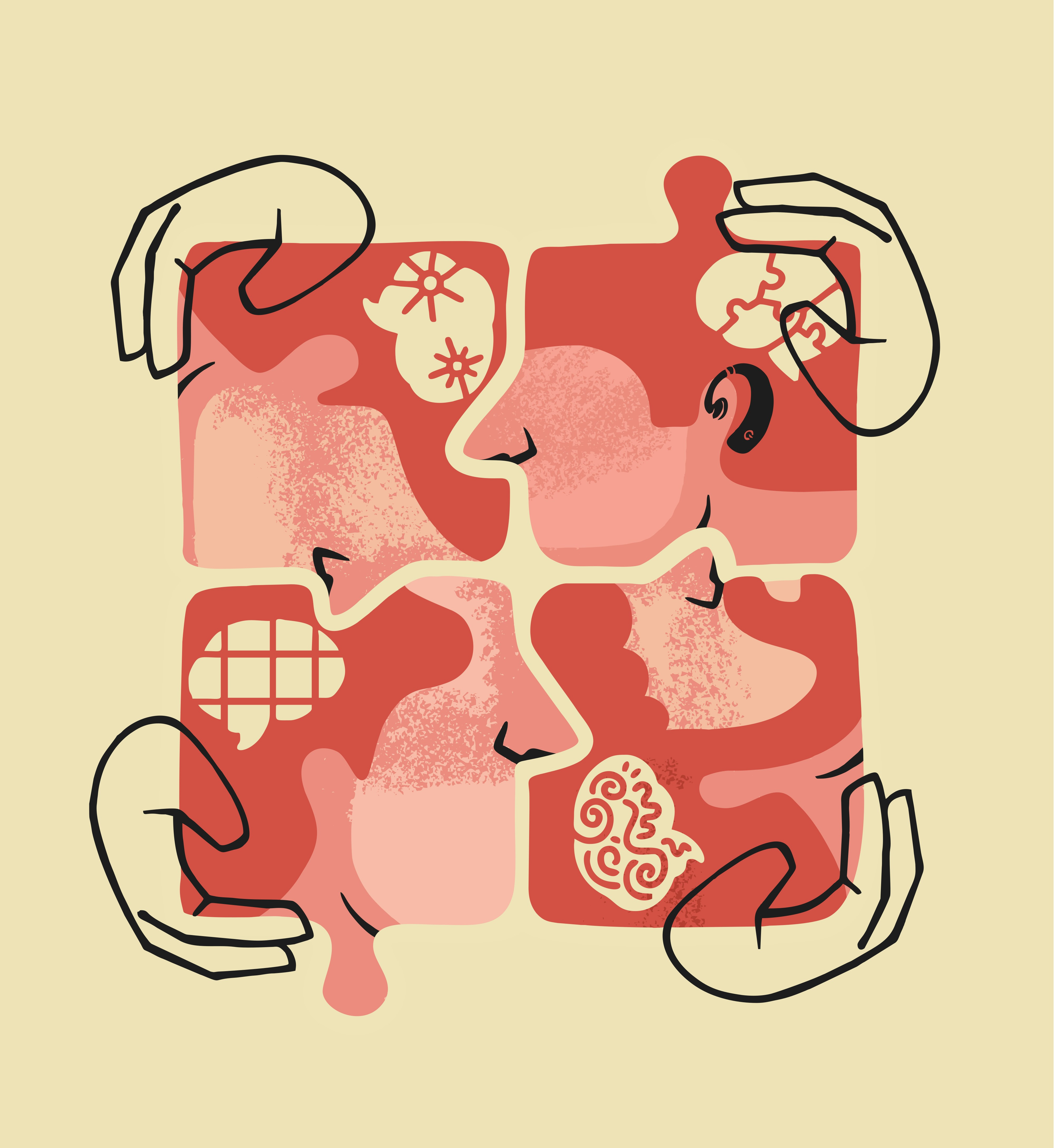
At the Palais de Tokyo in Paris, an exhibition called “ECHO DELAY REVERB: American Art, Francophone Thought” traces the transatlantic circulation of ideas, how the work of Simone de Beauvoir, Michel Foucault, Monique Wittig, Pierre Bourdieu and others crossed the ocean and was translated by American artists into unexpected forms, how theory became material became practice. It explores the various exchanges that have established a two-way flow of ideas between the French-speaking world and the United States.The exhibition features work from several generations of artists, but what strikes me isn’t the lineage. It’s the time gaps. The moments when an idea sat in transit for years, sometimes decades, unnamed, before someone on the other side of the ocean gave it form.
This is how culture actually moves. Not through trends we can identify and track, but through desires we can’t yet articulate, needs that exist in the body before the mind has words for them.
In Vol. 1 of THE FUTURES, I argued that we’re living through a creedal passion cycle—a period where inherited narratives about optimization, productivity, convenience, and aspiration are being actively rejected. The evidence is in the data: part-time work by choice, wellness spending doubling while engagement collapses, social media usage plateauing as people opt out.
But rejection is only half the story. What are people moving toward?
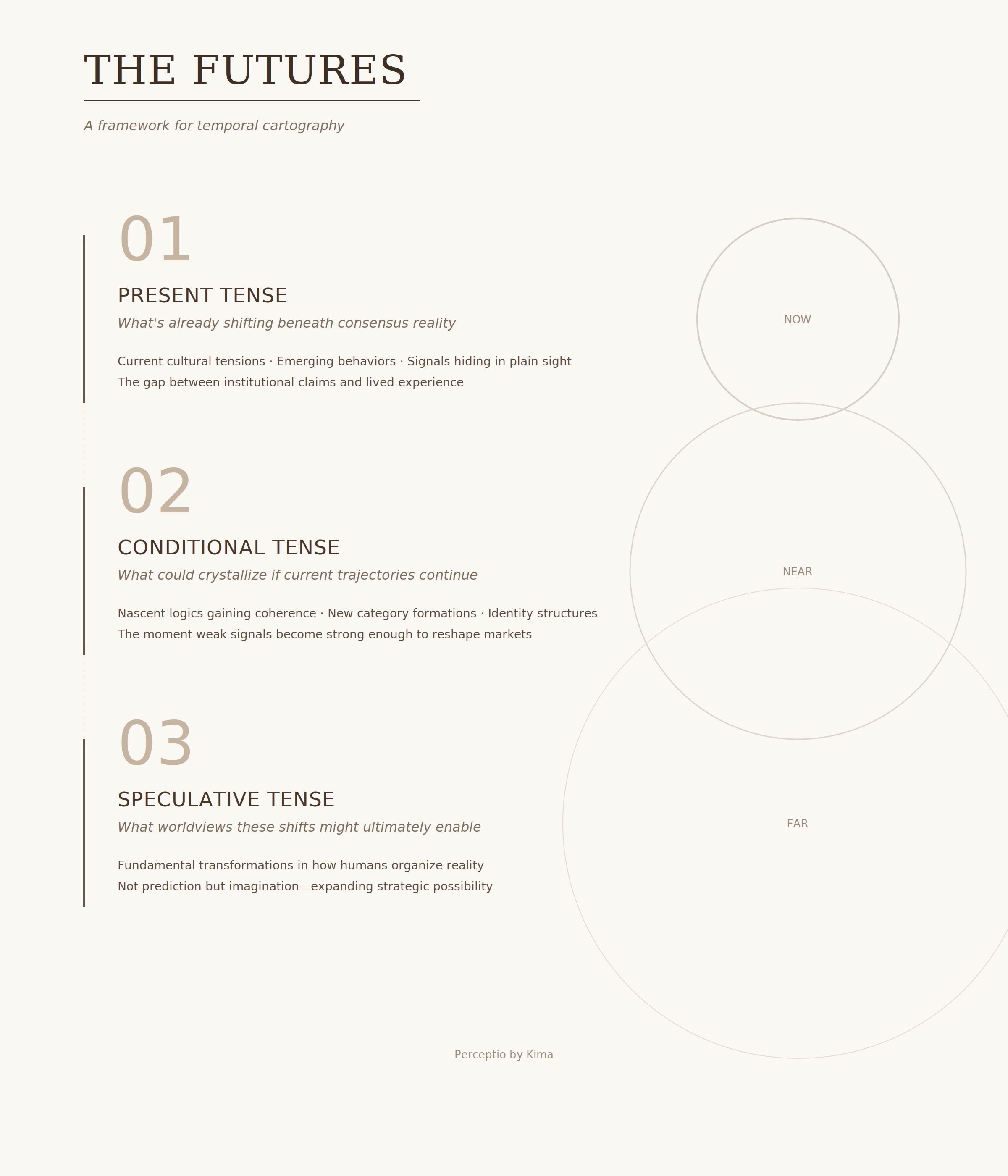
This essay maps three emerging needs: desires that don’t yet have clean names, that resist the language of the inherited future. Following the temporal cartography framework: what’s already shifting beneath consensus (present), what could crystallize if these trajectories continue (conditional), and what worldviews might ultimately emerge (speculative).
I. Temporal sovereignty - The desire for rhythm, not just time
Present: What’s already shifting
Consider how we currently live. Algorithms determine not just what we see but when we see it, optimizing for engagement metrics that reward speed. The “just one more” architecture of feeds exploits the way our attention naturally flows, redirecting it toward patterns that serve the platform rather than the person. Even our tools for productivity often accomplish this by subdividing our hours into ever-smaller increments, treating temporal fragmentation as the solution rather than the problem.
The unnamed need here isn’t for more time, everyone already wants that. It’s for temporal sovereignty: control over the rhythm and pace of your own experience when every system around you is optimized for acceleration.
The slow productivity movement, crystallized by Cal Newport’s work, has moved from the fringes into mainstream discourse. Its appeal isn’t really about working less, it’s about reclaiming authorship over the tempo of your own life. When Newport talks about doing fewer things and working at a natural pace, he’s describing a form of sovereignty: the right to set your own rhythm rather than accepting the one imposed by inbox and notification and feed.
Conditional: What could crystallize
What if organizations started competing on rhythm rather than speed? Not “we’re faster” but “we match your pace.” Healthcare that schedules around your energy and schedule, not administrative convenience. Education that adapts to attention cycles rather than fighting them. Work environments designed around creative rhythms such as deep focus, recovery, collaboration rather than constant availability.
The competitive advantage becomes coherence: helping people feel like their time belongs to them even while they’re giving it to you. The wellness economy’s record peak of $6.8 trillion in 2024 isn’t just about rest, it’s about buying back temporal control. That spending will increasingly flow toward organizations that treat time not as a resource to extract but as a relationship to honor.
Speculative: What worldview emerges
A society that treats temporal sovereignty as infrastructure, the way we treat roads and utilities. Public investment in “tempo commons” spaces and services designed to protect natural rhythms from commercial acceleration. The measure of a good employer, a good city, a good institution becomes: do people feel more sovereign over their time after encountering you, or less?
This represents a fundamental break from the inherited future, where speed was advantage and acceleration was progress. Move from “how do we capture more of people’s time?” and start asking “how do we help people feel sovereign over the time they have?
II. Witnessed solitude - The desire to be alone together
Present: What’s already shifting
In 1989, the sociologist Ray Oldenburg introduced the concept of “third places”—the cafés, barbershops, pubs, and parks where community happens outside the spheres of home and work. His warning then was that these spaces were becoming “a diminishing aspect of the American social landscape.” 37 years later, the diminishment is nearly complete. The loneliness epidemic is now a public health concern. Read more about third places below:

But here’s what’s strange: the solutions we’ve built don’t quite address the need. Social media promised connection and delivered performance. Co-working spaces promised community and delivered networking. Virtual communities promised belonging and delivered parasocial relationships with content creators we’ll never meet.
The unnamed need isn’t for more connection, it’s for witnessed solitude. Being alone, but in the presence of others. Not performing your existence for an audience, not networking toward some future transaction, but simply existing in a shared space where your presence is acknowledged without demanding your attention.
The old third places provided this almost accidentally. You could sit in a café and read, alone but surrounded. The bartender knew your name but didn’t need your conversation. You could be seen without being watched.
Conditional: What could crystallize
What if the loneliness epidemic sparked a design movement? Architects, urban planners, service designers all working on the same problem: how do you create spaces where people can be alone together? Public libraries expand their mandate. Parks are redesigned for parallel presence. A new category emerges in hospitality: not hotels, not co-working, but places built around the simple proposition of accompanied solitude.
The writer Adam Chandler recently proposed the concept of a “third life”, not a physical place but a framework for regular social engagement “safe from the reach of obligation or the temptation of performative busyness.” This framing will expand. Organizations that understand witnessed solitude will stop optimizing for engagement and start creating contexts for accompaniment.
Speculative: What worldview emerges
Communities rebuilt around presence rather than productivity. The question “what do you do?” replaced by “where do you belong?” Institutions (civic organizations, third places) that had been hollowed out by the platform era find new purpose as infrastructure for witnessed solitude. The social fabric repairs not through more connection, but through better presence. This is a direct rejection of the platform logic that has dominated the past two decades.
III. Earned difficulty - The desire for difficulty worth choosing
Present: What’s already shifting
Ruth Asawa’s retrospective at MoMA spans six decades of work—the looped wire sculptures that took months to complete, the paper folds, the paintings, the public commissions. What’s striking is the labor. These are objects that couldn’t have been made any other way. The process is inseparable from the form.
We live in an age of frictionless delivery: same-day shipping, instant streaming, one-click purchase. The prevailing logic has been to remove obstacles between desire and satisfaction. And in many contexts, this makes sense. No one wants to struggle to send an email or make a phone call.
But something else is happening beneath the surface. A countermovement toward difficulty: the rise of film photography, the vinyl revival, the explosion of running clubs and endurance events, the popularity of craft goods. Even the “de-influencing” trend on TikTok, where creators discourage people from buying products that promise easy solutions.
The unnamed need here is for earned difficulty—the desire for experiences, objects, and practices that require real investment of time, attention, or skill. Not struggle for its own sake, but the kind of effort that makes the outcome meaningful precisely because it couldn’t be obtained any other way.
Conditional: What could crystallize
What if businesses started treating customer effort as an asset rather than a liability? Not artificial friction, but genuine participation. Services that teach while they deliver. Products that improve as you develop skill with them. The relationship between company and customer becomes collaborative rather than transactional. You’re not buying an outcome, you’re investing in a practice. Loyalty isn’t purchased with points; it’s earned through shared effort.
The framing matters: not deprivation, but investment. Not scarcity for its own sake, but the creation of value through the very act of spending effort. The organizations that understand this will stop competing on convenience and start competing on worthiness of effort.
Speculative: What worldview emerges
An economy that values contribution over consumption. The question shifts from “what can I get?” to “what can I build?” Work, learning, and leisure blur because investment itself becomes the source of meaning. The throwaway culture of frictionless delivery gives way to something more durable: objects, services, and relationships worth the effort they require.
Mapping the counter-rhythm
Temporal sovereignty, witnessed solitude, earned difficulty are symptoms of the same underlying shift I identified in Vol. 1: the inherited narratives are failing, and people are building alternatives with their behavior before they can articulate it in language.
Each need is a rejection:
Temporal sovereignty rejects optimization-as-virtue
Witnessed solitude rejects connection-as-performance
Earned difficulty rejects convenience-as-value
And each points toward a different foundation for what comes next.
The challenge is that these needs are hard to research in conventional ways. You can’t run a survey asking people if they want witnessed solitude, because they don’t have words for it yet. You can’t A/B test your way to temporal sovereignty. The emerging future can’t be captured by the methods designed to optimize the inherited one.
What you can do is look at culture, not at trend reports, but at the art and the ideas and the practices that people are gravitating toward when they’re not being watched or measured.
The Palais de Tokyo exhibition about ideas crossing oceans and arriving transformed. The quiet ways people are opting out of optimization.
I believe that the products, brands or organizations that will define the next decade won’t be built by finding efficiencies in existing categories. They’ll be built by those who can sense these unarticulated needs, who can create forms before the vocabulary exists and who understand that sometimes the most valuable thing you can offer people is not what they asked for, but what they didn’t yet know how to want.
These three needs point toward futures that don’t yet exist. In Vol. 3, we’ll explore how organizations can hold multiple futures simultaneously—not choosing one prediction, but building the capacity to move toward whichever emerges.
Read VOL.1

More about third places
About Kima
Kima Sargsyan is a strategist and narrative consultant writing Perceptio. She works with founders and execs on how their company is seen and how to shape it.
Want to keep talking?