

Decentering English as the default language of global entertainment.
We don't need to understand the language to enjoy the work.

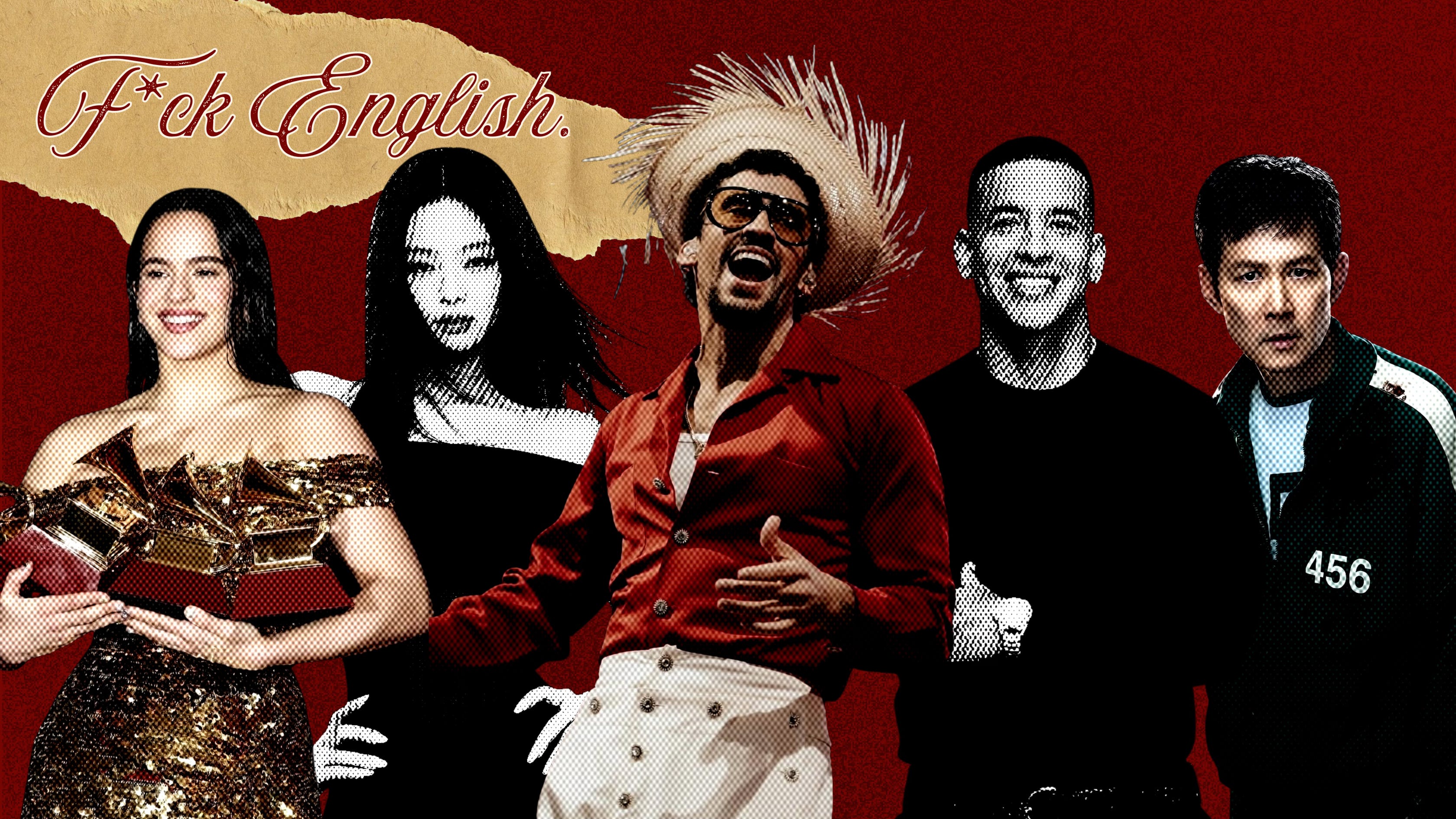
Rosalía’s “Berghain” isn’t just an amazing song, but also a sign of a profound cultural shift. When the Spanish superstar released this multilingual track, fluidly weaving between Spanish, English and German, something remarkable happened. Rather than limiting her audience, this linguistic complexity expanded it. The song captivated global listeners through its visual storytelling, layered meanings, and Rosalía’s undeniable artistry, rendering complete linguistic comprehension secondary to the emotional connection.
What’s truly interesting is the audience response. On TikTok, Instagram and Reddit, fans celebrate the multilingual approach as enhancing the song’s authenticity. They create collaborative translation threads, analyze the significance of each language choice, and share interpretations across borders. Not understanding every word has become part of the experience rather than an obstacle to it. The partial comprehension creates engagement, inviting listeners into active participation rather than passive consumption.
Rosalía is part of a broader shift that didn’t happen overnight. Luis Fonsi’s “Despacito” broke multiple records at some point to become the most-streamed song without compromising its linguistic identity. Bad Bunny dominates global charts without releasing English versions. Blackpink sets YouTube global records with Korean lyrics. “Squid Game” and “Money Heist” became some of the Netflix’s biggest hits.
We’re witnessing the decentering of English as the default language of global entertainment, a fundamental restructuring of cultural capital that carries profound implications for brands, creators, and consumers alike.
The evidence is undeniable.
The transformation in viewer habits tells a compelling story. For the first half of 2025, non-English titles on Netflix made up more than one-third of all viewing hours. According to Ampere Analysis, regular viewing of international (non-English language) TV shows and movies has increased by 24% among 18 to 64-year-olds in the UK, USA, Australia, and Canada in the last four years (since Q1 2020).
This engagement extends beyond passive viewing to active participation. When “Squid Game” dominated global conversation, Duolingo recorded a remarkable surge in new Korean learners within a single month. Viewers aren’t just watching – they’re investing in a deeper cultural connection.
The economic implications are profound. IFPI’s industry analysis shows non-English music streaming growing at 34% annually, nearly triple the 12% growth rate for English-language music between 2019 - 2024. Meanwhile, Spotify’s Culture Next Report (2023) documents that 58% of GenZs in the US say they like music that’s not in their native language.
From colonial legacy to global remix
English didn’t become the global lingua franca through natural selection. Its dominance was established through British colonialism, cemented through American economic power, and maintained through Hollywood’s global distribution machine. For decades, non-English content was treated as niche relegated to “world music” sections and “foreign film” categories, culturally significant perhaps, but commercially marginalized.
What’s revolutionary today is that linguistic diversity is emerging through consumer choice rather than institutional mandate. When Bad Bunny’s “Un Verano Sin Ti” becomes Spotify’s most-streamed album globally while remaining in Spanish, it reflects a profound shift in audience willingness to engage with unfamiliar languages.
What we’re witnessing isn’t cultural evolution, it’s linguistic liberation on a scale most executives still don’t fully comprehend.
The forces driving the shift
This linguistic transformation doesn’t exist in isolation, it’s powered by converging sociopolitical, technological, and cultural forces creating the perfect conditions for this change.
Sociopolitical undercurrents
Success no longer requires linguistic assimilation to English-speaking markets. Instead, authentic expression in one’s native language has become a competitive advantage.
Simultaneously, diaspora communities have evolved from cultural isolation to cultural bridges. Second- and third-generation immigrants are increasingly embracing heritage languages as assets rather than liabilities.
Technology as an enabler
Three technological breakthroughs made this linguistic diversification commercially viable:
Advanced subtitle technology: Machine learning algorithms have dramatically reduced the cost and improved the quality of subtitling across multiple languages, removing a key barrier to global distribution.
Recommendation algorithms: Platforms now confidently suggest content based on taste rather than language, creating cross-linguistic discovery.
Global production infrastructure: Digital tools have democratized high-quality production across regions previously excluded from global entertainment.
Korean filmmaker Bong Joon-ho captured this moment perfectly after his Oscar win: “Once you overcome the one-inch-tall barrier of subtitles, you will be introduced to so many more amazing films.”
What sounded like an artistic statement was actually describing a technological and commercial revolution.
The economics of linguistic diversity
This shift is not primarily driven by idealism or cultural appreciation. It’s cold, hard economics. The global music industry realized that English-language dominance was artificially constraining market potential. Streaming platforms facing saturation in North American markets discovered that authentic local-language content drives international subscriptions more effectively than exported American shows.
BTS’s economic impact on South Korea has been estimated at $4.655 billion annually – a figure that convinced other markets that linguistic authenticity could be financially rewarding. Bad Bunny’s 2022 tour grossed $435 million while performing almost entirely in Spanish, proving global audiences will pay premium prices for experiences in languages they don’t fully understand.
Even climate consciousness plays a role in the economic equation. As awareness of travel’s environmental impact grows, content consumption increasingly functions as virtual cultural tourism.
The emerging linguistic hierarchy
Not all languages and content are benefiting equally from this disruption. Spanish, Korean, and Japanese have emerged as leaders, succeeding through a combination of strong creative industries, strategic cultural export policies, and distinctive genres. For instance, South Korea’s emergence as a content superpower didn’t happen entirely organically—it resulted from decades of deliberate cultural policy. The Korean government invested approximately $5 billion in cultural industries between 1994 and 2019, positioning entertainment as a strategic export sector.
Beyond consumer choice: The deeper “why”
While we can measure the shift in consumer behavior, the underlying motivations reveal even more profound changes:
The quest for authenticity: In an era of AI-generated content and corporate homogenization, consumers increasingly value genuine cultural expression. Original language content feels more “real” than dubbed or translated versions, providing an escape from sanitized global culture.
Cultural exploration as status: As material status markers become less relevant, cultural capital has risen in importance. Being conversant in global content signals cosmopolitanism and sophistication - the ability to appreciate Korean cinema or Spanish music becomes a social distinction marker.
Reaction against homogenization: After decades of globalized culture that flattened differences, there’s a powerful counter-movement celebrating specificity and uniqueness. This mirrors similar trends in food culture, where authentic regional cuisines have surged in popularity over standardized international fare.
Digital natives and cognitive flexibility: Younger millennials and GenZ have grown up in a digitally connected world where switching between contexts is normal. They’ve developed greater flexibility and comfort with ambiguity that makes linguistic diversity less intimidating and more intriguing.
Parasocial relationships transcend language: Fans develop emotional connections with creators and artists that survive language barriers. The emotional authenticity of Bad Bunny’s expression matters more than word-for-word comprehension, creating relationships with artists that transcend linguistic understanding.
Strategic implications for brands
For global brands, this shift demands more than just box-checking diversity and localization initiatives:
1. From translation to cultural fluency. Simply translating existing campaigns is insufficient. Successful strategies now involve cultural adaptation from inception. Coca-Cola’s global campaign structure, allowing for local cultural execution, exemplifies this approach.
2. Creator collaborations over appropriation. Authentic collaboration with artists and creators from specific cultures provides both credibility and built-in audience access. Adidas’ partnership with Bad Bunny resulted in instantly sold-out product drops precisely because it respected his cultural authority.
3. Platform-specific cultural strategies. Different platforms have distinct linguistic patterns. TikTok has emerged as particularly language-agnostic, with viral trends regularly crossing linguistic boundaries, while Instagram remains more linguistically segregated.
4. Cultural intelligence as a competitive moat. Organizations that develop genuine cross-cultural competency create barriers to entry that competitors struggle to overcome. I don’t mean just hiring diverse teams, but also building systems that identify and leverage cultural trends before they reach mainstream awareness.
The future landscape
This linguistic diversification will continue accelerating, with several emerging trends on the horizon:
Multilingual mixed content: Content that seamlessly integrates multiple languages within a single work will become common, as seen in films like “Everything Everywhere All at Once” with its Mandarin-English-Cantonese mix.
Translation-resistant art: As language barriers lower, expect a countertrend of deliberately translation-resistant content that emphasizes linguistic specificity as artistic value, already emerging in literary fiction and experimental music.
New regional powerhouses: Content from currently underrepresented regions, particularly Africa and the Middle East, will gain global traction as investment follows successful models from Latin America and Asia.
Integrated learning experiences: Entertainment-based language learning will integrate directly with content platforms, enabling viewers to develop vocabulary while engaging with content they enjoy.
Strategic action steps
For brands and content creators navigating this shift, five key actions emerge:
Audit your linguistic strategy: Is your organization still defaulting to English-first approaches? Are you investing in authentic content across languages?
Develop cultural fluency capabilities: Build teams capable of identifying and leveraging global cultural trends before they reach mainstream awareness.
Rethink audience segmentation: Move beyond geographic and demographic models to identify taste communities that transcend linguistic boundaries.
Create participation opportunities: Design experiences that allow audiences to engage with linguistic diversity rather than merely consume it.
Embrace the authenticity premium: Recognize that linguistic authenticity now carries commercial value rather than commercial limitations.
English isn’t being abandoned but repositioned.
The beauty of this decentered approach lies not in perfect understanding but in participation in the willingness to engage with unfamiliar expressions, to embrace partial comprehension, to value authentic voices over convenient translation.
English isn’t being abandoned but repositioned as one voice in a growing global chorus rather than the assumed default. Through this global language exchange, we’re building more connected cultural experiences in a world where linguistic diversity has become not just culturally enriching but commercially essential.
This analysis draws from my work tracking global cultural trends across markets. How has your own consumption of music, media, and content changed linguistically in recent years? Your personal shifts likely mirror broader market transformations that are reshaping global culture.
As a multilingual person who takes in entertainment across two or three languages, this was a joy to read. Do you think we're heading toward a handful of globally dominant entertainment languages, or will any language have a genuine shot at producing breakout art and content?